Lost Stories Gem #10
What the Books of Enoch Tell Us About Human Origins
Most of us learned in school that humanity developed in predictable stages. First came hunter-gatherers with nothing but oral traditions. Then came the slow invention of tools and fire. Thousands of years later, writing finally emerged, and with it came civilization. According to this secular narrative, knowledge has always grown gradually, painfully, over countless millennia. Humans clawed their way from savagery to sophistication entirely through trial and error.
But what if this timeline is incomplete? What if the books of Enoch and the narrative of the fallen angels—or Nephilim as they are called in Genesis—suggest something radically different about human origins and our ability to record knowledge?
The Lost Stories Channel exists to challenge narrow-minded interpretations of history by harmonizing artistic, scientific, and theological perspectives. When we examine what the books of Enoch actually reveal, we uncover a narrative that stands in stark contrast to secular assumptions. We find a story in which advanced knowledge, writing, and divine instruction didn’t develop slowly over millennia. Instead, they were transmitted directly from God to humanity through a figure whose name became synonymous with wisdom itself across multiple ancient civilizations.
The Secular View of Writing’s Origins
According to conventional historical scholarship, writing emerged only after extensive periods of oral culture. The timeline typically goes like this:
Oral Tradition (roughly 200,000 to 3500 BCE): Knowledge survived purely through human memory, song, and storytelling
Proto-Writing (around 7000 to 3500 BCE): Clay tokens and marked tablets began tracking commodities
Cuneiform (circa 3200 BCE): The Sumerians developed wedge-shaped symbols pressed into wet clay
Egyptian Hieroglyphs (circa 3100 BCE): Pictorial symbols representing objects and sounds emerged
The Phoenician Alphabet (around 1050 BCE): A phonetic system that democratized literacy
This progression suggests that writing was invented slowly, independently by different cultures, each building on trial and error. According to this view, the shift from memory to records transformed human cognition and enabled civilization itself. Without writing, there could be no empires, no philosophy, no science.
What this narrative overlooks is the possibility of divine instruction as a source of knowledge transfer. It assumes that all human advancement must come from within human capability alone.
Enoch the Scribe: A Biblical Alternative
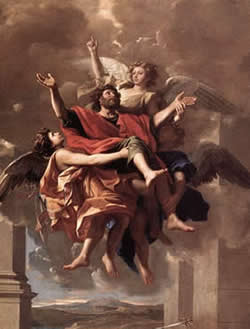
The Book of Genesis offers a puzzling account: “And Enoch walked with God: and he was not; for God took him.” The Book of Hebrews adds context: “By faith Enoch was taken away so that he did not see death, and he was not found, because God had taken him.”
But what was Enoch’s actual purpose? The extra-biblical texts, particularly The First Book of Enoch, provide a stunning answer. Enoch was called upon as a scribe. According to First Enoch:
“And I, Enoch, was blessing the Lord of majesty and the King of the ages, and suddenly, the Watchers called me, Enoch the scribe, and they said to me: ‘Enoch, you scribe of righteousness, go and declare to the Watchers of Heaven.’”
Why was he specifically called “the scribe”? Because God commanded him to write. He composed “the book of the words of righteousness, and of the reprimand of the eternal Watchers in accordance with the command of the Holy Great One.”
Then comes perhaps the most significant detail. The Secrets of Enoch records God telling him:
“Apply your mind, Enoch, and know Him Who is speaking to you, and take the books which you yourself have written. Give your children the books of the handwriting, and they will read them and will understand how there is no other God but Me. And let them distribute the books of your handwriting, children to children, generation to generation, and nations to nations.”
Here we have something the secular timeline can’t explain: a divinely commanded system for recording and distributing knowledge through written text. Not human invention, followed by gradual innovation. Not oral transmission slowly giving way to writing. Instead, direct instruction to write and preserve knowledge for all future generations.
The Fallen Angels Connection
The books of Enoch are inseparable from the narrative of the fallen angels and the Nephilim. According to Scripture and the extra-biblical texts, the Watchers descended from Heaven with knowledge that they weren’t meant to share with humanity. Enoch’s role as scribe took on cosmic significance in this context. He was commanded to confront these Watchers, to record their crimes, and to preserve God’s righteous judgment against them.
This detail matters for understanding human origins. The fallen angels imparted forbidden knowledge to humanity, corrupting God’s design. Enoch’s task was to document this transgression and to preserve the true account for posterity. Writing itself became an instrument of divine justice and truth preservation.
Ancient Echoes Across Civilizations
Here is where secular and biblical accounts begin to harmonize in unexpected ways. Consider the testimony of E.A. Wallis Budge, the renowned British Egyptologist who translated The Egyptian Book of the Dead. According to Budge’s scholarly research, the Greeks knew Enoch as Hermes, messenger of the gods. Remarkably, Hermes was believed to be the only deity officially authorized to visit Heaven. He was also the god of transitions and boundaries, serving as an intercessor between the natural and divine realms.
But the Egyptians knew this figure even earlier as Thoth, god of wisdom. According to Budge, Thoth was “the scribe of the gods.” His titles included “lord of writing,” “master of papyrus,” and “maker of the palette and the ink-jar.” The Egyptians credited Thoth with inventing writing itself and all the arts and sciences known to their civilization.
Consider what this means. Across multiple ancient cultures separated by geography and time, a figure emerges who is consistently associated with writing, divine wisdom, and communication between Heaven and Earth. The details match too precisely to be accidental. The biblical Enoch, the Greek Hermes, and the Egyptian Thoth all embody the same attributes: scribe, messenger, founder of knowledge systems.
What This Tells Us About Human Origins
When we bring these three sources together, a striking picture emerges. The secular narrative insists that writing developed slowly over millennia through human experimentation. Yet the biblical and mythological records suggest something different: that knowledge transmission through writing was established at humanity’s foundation through divine appointment.
This doesn’t necessarily contradict the development of various writing systems. Rather, it suggests that the practice of preserving and transmitting knowledge through written records originated not from gradual invention but from direct divine instruction given to a man like Enoch. The different civilizations that later developed their own forms of writing were building upon a tradition already established in human culture.
The prevalence of Enoch-like figures across ancient mythologies isn’t coincidental. It’s the trace of a truth so profound and indelible that it resurfaces across cultures and centuries, even when the original narrative has been filtered through multiple retellings and cultural transformations. Truth, when planted deeply enough, can’t be fully erased. It merely transmutes into new forms.
A Different Understanding of Progress
The secular view positions humanity as slowly climbing from ignorance toward knowledge through its own efforts alone. But in light of what we’ve just considered, we see, instead, that humanity began with direct access to divine knowledge, fell into corruption through the influence of the fallen angels, and then had to recover what was lost.
This isn’t primitive superstition. This is a coherent narrative that explains both why ancient civilizations possessed sophisticated knowledge systems and why those systems were sometimes distorted or obscured. Enoch’s role as scribe becomes crucial: he was preserving the true account of the influence of those who sought to corrupt humankind.
Looking Beyond Single-Discipline Thinking
The Lost Stories Channel rejects the narrow approach that examines evidence through only one lens. When we look at human origins through Scripture alone, we miss certain insights. When we examine only secular archeology and anthropology, we overlook the theological dimensions. But when we harmonize these perspectives, something remarkable becomes visible.
The books of Enoch don’t contradict the existence of early civilizations or the development of various writing systems. They provide a foundation for understanding how and why writing emerged at all. They explain why knowledge systems appeared with such sophistication in ancient cultures. And they offer a framework for understanding why the same archetypal figure appears across mythologies separated by vast distances and time.
Humanity didn’t invent writing in a vaccum. It was divinely inspired; and then—almost certainly with the Flood of Noah meant to remove the Nephilim—writing was lost in the chaos that followed. Only then did humans eventually recover the art of writing, adapting it and building upon it in subsequent ages. And at the source of that knowledge stands a figure named Enoch—called the scribe—who walked with God and was commanded to preserve the truth for all generations to come.
If you are drawn to this kind of integrated thinking about history and faith, where artistic, scientific, and theological perspectives combine to reveal deeper truths, The Lost Stories Channel offers extensive exploration of these themes. Our catalog includes works that examine biblical narratives not as isolated religious texts but as historical records that illuminate what secular sources often overlook. Discover how long-lost knowledge can be recovered and made accessible to any reader willing to look beyond conventional boundaries.


