Lost Stories Gem #4
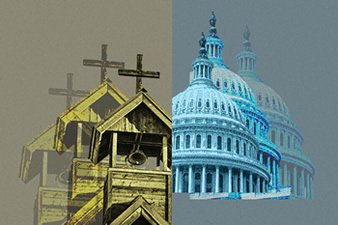
Did America’s Founders Intend to Build a Christian Nation?
The question seems simple enough on the surface: Did the men who founded the United States intend to build a Christian nation? But the moment you start pulling on that thread, the whole tapestry of American history comes with it. Depending on who you ask, the Founders were either devout Christians planting the seeds of a biblical republic, or secular rationalists who deliberately scrubbed religion from public life. Neither portrait is fully accurate, and that gap between the caricature and the reality is exactly where the most important conversations need to happen.
The Lie That Keeps Getting Repeated
One of the most persistent myths in American political life is that the separation of Church and State was designed to remove The Bible and its teachings from the public square. It sounds reasonable at first glance. The First Amendment does prohibit Congress from establishing a religion, and that clause has been stretched, over generations of selective interpretation, into something the Founders would barely recognize.
But read the historical record carefully and a very different picture emerges. The separation doctrine was not designed to exile faith from civic life. It was designed to protect the rights of every citizen by preventing the government from establishing or promoting any single denomination, and by preventing any church from wielding coercive power over those who practice their faith differently.
That is a meaningful distinction, and it’s one that gets lost when narratives are curated to serve particular agendas rather than to reflect what actually happened.
What the Founders Actually Said
John Quincy Adams left very little ambiguity on the subject. He wrote: “The highest glory of the American Revolution was this: it connected in one indestructible bond the principles of civil government with the principles of Christianity.”
That isn’t the language of a man trying to build a wall between faith and public life. It is the language of a statesman who saw the two as inseparable parts of the same foundation.
Daniel Webster was equally direct. He warned his fellow citizens: “Never forget the religious character of our origin. Our Fathers were brought here by their high veneration for the Christian religion. They journeyed by its light, and labored in its hope. They sought to incorporate its principles into every aspect of American society, and to diffuse its influence through all their institutions—civil, political, and literary.”
These aren’t fringe quotations dug up to prove a point. They are central statements from central figures, and they deserve to be read in full rather than explained away.
Three Distortions Worth Naming
When you look at the most common arguments used to dismiss the Christian influence on America’s founding, a pattern emerges. The same handful of distortions keeps showing up:
The Secularist Distortion: The Founders were Enlightenment rationalists who tolerated religion but kept it out of their political thinking. This ignores the overwhelming weight of their own written testimony.
The Theocracy Distortion: Anyone who argues for a connection between Christianity and American governance must secretly want a state-run Church. This is a false choice. Acknowledging biblical influence isn’t the same as calling for religious coercion.
The Escapist Distortion: Because human governments are temporary and God’s kingdom is eternal, Christians should stay out of politics entirely. This view, however well-intentioned, produces exactly the kind of disengaged citizenry that allows corruption to fill the vacuum.
That third distortion deserves special attention. The promise of a higher destiny can bring real comfort, but it can also become an excuse for passivity. Adams spoke to this directly when he wrote: “Whoever believes in the divine inspiration of Scripture must hope that the religion of Jesus shall prevail throughout the Earth, and that the prospects for that hope have rarely looked more encouraging.” Hope, in other words, isn’t a reason to step back from the world. It’s a reason to step further in.
Common Sense Over Comfortable Tradition
The problem with most versions of this debate is that they draw on a single discipline and ignore the rest. Most political historians read the founding documents through a secular lens, while most theologians read them through a lens so narrow that they can’t account for the complexity of the Founders’ actual beliefs. Neither approach produces a complete picture.
A more honest reading requires what might be called a synthesis: bringing artistic, scientific, and theological perspectives into conversation with one another, checking each conclusion against the others before drawing any final claim. That is a firm foundation for understanding American history, and it is the only approach that takes the evidence seriously rather than sorting it in advance.
The Founders themselves modeled this kind of thinking. They read widely, debated fiercely, and refused to let any single tradition hold a monopoly on truth. Common sense, for them, was not an insult to scholarship. It was the standard by which scholarship was measured.
Why This Still Matters Today
It would be tempting to treat this as a purely historical argument, a debate about dead men and old documents. But the way a society reads its own founding shapes everything that comes after it. If a generation grows up believing the Founders were secular rationalists who had no use for biblical principles, that generation will interpret the Constitution very differently from one that understands the actual record.
The narratives we absorb from schools, media, and even church teaching are not neutral. They are shaped by choices about what to include and what to leave out. Recognizing that dynamic is not cynicism. It is the beginning of responsible citizenship.
And responsible citizenship, grounded in both faith and reason, is precisely what the Founders were trying to cultivate. They did not want a population that outsourced its thinking to institutions. They wanted an informed, morally grounded people capable of self-governance, and they believed that the principles found in Scripture were uniquely suited to producing exactly that.
Recovering What Has Been Lost
The good news is that the historical record has not been destroyed. It has been obscured, selectively quoted, and sometimes deliberately misread, but the primary sources remain. The letters, speeches, and published works of the Founders are still available, still readable, and still capable of surprising anyone willing to approach them without a predetermined conclusion.
The Lost Stories Channel exists precisely to help readers do that kind of recovering. The book Lies My Professor Told Me About American Politics takes on these founding-era distortions directly, tracing the gap between what the historical record actually shows and what has been handed down through generations of selective teaching. If you have ever felt that the story you were told about America’s origins does not quite add up, that instinct is worth following.
The evidence is there. The question is whether we are willing to look at it honestly, and to let it change what we think we already know.


