Lost Stories Gem #26
How The Old Testament Foreshadows The New
Biblical typology is the doctrine that certain events, persons, and statements in The Old Testament function as “types” or “shadows” that prefigure specific aspects of Christ’s life and redemptive work. The Apostle Paul articulated this concept with crystal clarity when he wrote: “Don’t let anyone judge you about food, or drink, or festivals, or new moons, or Sabbaths, which are all but shadows of things to come, but the substance is Christ.”
This isn’t a modern invention or an obscure theological concept reserved for scholars. Rather, it’s a foundational lens through which we can understand how God communicates His plan of redemption throughout history. When we recognize biblical typology, we see that God operates like a cosmic director, carefully weaving patterns and parallels throughout Scripture so that we can’t fail to recognize the connection between The Old Testament and the coming of Christ.
Those familiar with cinematic storytelling understand the power of foreshadowing and payoff. A skilled director plants details early in the film that only make sense when the final act unfolds. Biblical typology works the same way. God planted “echoes” of Christ’s coming throughout The Old Testament, so that when Christ arrived, those who had eyes to see could recognize the fulfillment of those promises pertaining to His arrival.
Isaac as a Type of Christ
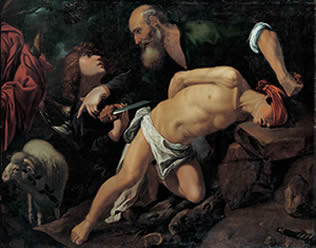
One of the most striking examples of typology appears in the account of Abraham’s willingness to sacrifice his son Isaac on Mount Moriah. In this narrative, we see Isaac functioning as a “type” of Christ the Son, while Abraham serves as a “type” of God the Father.
Consider the parallels:
Isaac was the beloved son of Abraham, supernaturally conceived through divine intervention in Sarah’s barren womb
Jesus was the beloved Son of God, born miraculously through divine intervention
Abraham was commanded to offer up his son as a burnt offering
God the Father offered up His Son Jesus as a sin offering on Calvary
Both events occurred on a mountain where God required the ultimate sacrifice
As biblical scholar Cyrus H. Gordon noted with elegance: “Jesus derives His human office of Messianic King from Joseph, but His divine quality from His Divine Father. Moreover, the church tradition that connects the sacrifice of Isaac with the sacrifice of Christ apparently rests on sound exegesis, for the sacrifice of Isaac would have meant not only the sacrifice of Abraham’s son but of God’s.”
The pattern is unmistakable. God was teaching humanity through The Old Testament narrative what would later be fulfilled in The New Testament reality.
Joseph: The Most Complete Type
When we examine the life of Joseph, the beloved son of Jacob, we discover something remarkable: biblical scholars have identified no fewer than seventy distinct ways in which Joseph foreshadows Christ. A few of the most compelling parallels include:
Both Joseph and Jesus were outspoken about their glorious futures in which they would rule as kings, and both engendered hatred from their family members as a result
Both men were imprisoned, though destined for greatness. Joseph was imprisoned in Egypt; Jesus was imprisoned in Hades
Both were punished alongside two other men. Joseph encountered Pharaoh’s butler and baker in prison, while Jesus hung alongside two thieves on the cross
The evils perpetrated upon both men were “turned inside out” through divine providence. Rather than destroying them, those very circumstances led to their exaltation
Neither was immediately recognized by their brothers after their supernatural elevation to power
As such, Joseph stands as the most fully developed type of Christ in all of Scripture. His life reads almost like a detailed outline of what Christ would accomplish centuries later.
The Pattern of Resurrection Throughout Scripture
One of the most profound patterns running through The Old Testament is the theme of resurrection, which reaches its ultimate fulfillment in the resurrection of Jesus. This wasn’t an isolated, unprecedented miracle that appeared from nowhere. Rather, the resurrection of Christ was the culmination of a pattern that God had been establishing throughout biblical history.
In the canonical books, Elijah raised the widow’s son. Elisha was involved in two resurrections: he raised the Shunemite’s son, and a corpse was brought back to life merely by touching his bones. These accounts prepared God’s people to recognize that resurrection wasn’t an aberration but was actually part of God’s established order.
Beyond the canonical record, apocryphal texts reveal even more typological patterns. In The First Book of Adam and Eve, that first couple faced exile from Eden but were repeatedly raised from death and restored by the pre-incarnate Christ to fulfill the lifespan God had ordained for them. In The Secrets of Enoch, when Enoch was taken up to Heaven, his family believed him lost forever, only to have him return alive and well, as one raised from the dead.
In The Book of Jasher, Abraham as a young man survived three days in Nimrod’s fiery furnace. Similarly, Shadrach, Meshach, and Abednego survived the flames in Babylon. Both accounts foreshadow the three days Christ spent in Hades between His death and resurrection. These aren’t coincidences. They are God’s way of teaching us that death itself doesn’t have the final word.
Why God Uses Types and Shadows
Why would God use this method of communication through typology? The answer reveals something profound about how God views us as His people.
God understands how stubborn and skeptical we humans are as a species. Rather than simply telling us about His redemptive plan in abstract theological terms, He chose to teach us through patterns, through narrative, through history itself. He knew that we would need concrete, repeating demonstrations of His faithfulness. He recognized that we learn through stories, through seeing patterns emerge across time.
In other words, God is ever in the business of spoon-feeding humanity a gradual knowledge of His redemptive plan. Every age receives messianic figures who lead each generation of the faithful to the next level of awareness of God’s plan that ticks away like some great celestial clock, with its persistent, methodical unfolding of time. From God’s perspective, this rescue effort from the clutches of death, Hell, and the grave has taken only a few “days” to fulfill. But from our perspective, it has required many long and excruciating centuries.
But think of it this way: a traveler needs milestones along the roadside to complete a journey without getting lost. Without understanding the types and shadows that pointed to Christ, we would have been like sheep without a shepherd, lacking the guidance necessary to recognize God’s redemptive plan unfolding in real time.
Recognizing the Big Picture
When we step back and look at the “big picture,” the parallels in time become undeniably consistent with God’s attempt to convey the truth of His plan throughout the ages. Isaac, Joseph, and countless other Old Testament figures weren’t random historical accounts. They were carefully positioned signposts along humanity’s journey toward redemption.
This grand tapestry in time is what finally becomes clear when artistic, scientific, and theological perspectives are harmonized together. A purely historical reading of these accounts might treat them as disconnected stories. A purely theological reading or symbolic explanation might seem abstract and distant from real life. But when we synthesize all three perspectives, we see that God was operating at multiple levels simultaneously, communicating truths that would resonate across centuries.
The Old Testament isn’t a collection of quaint ancient tales. It’s a vast repository of encoded wisdom, hidden in plain sight, waiting for those with eyes to see and ears to hear. When we understand biblical typology, we discover that every major account in Scripture was designed to teach us something essential about Christ and His redemptive work.
The Lost Stories Channel exists to help you explore these connections, to recover long-lost knowledge that mainstream education often overlooks, and to harmonize faith, history, and theology in ways that lead to genuine understanding. As you journey deeper into Scripture, may you discover the profound beauty of a God who loved us enough to leave a trail of shadows pointing toward the Light of the World.


